MIP 2026 Logo

Mixed Integer Programming Workshop 2026

May 18-21, 2026

University of Connecticut - Stamford Campus

Posters

The 2026 MIP Workshop will include a poster session.

Abstract Submission

We invite poster abstracts to be submitted using this form. The poster session is reserved for undergraduate and graduate students (specifically who have not been awarded a PhD degree by the day of the deadline). The abstract format is a PDF file of at most two pages (letter format, 1 inch margin, font size 12pt, including references, tables, etc.).

The deadline for poster submissions is February 28, 2026 (11:59pm "Anywhere on Earth" time), and the committee will communicate decisions by March 16, 2026.

To accommodate international participants who may require extra time to secure a visa to attend the workshop, we offer the option to request an expedited decision. This can be selected in the form when submitting the abstract, and it will only be available for submissions completed by January 31, 2026. We anticipate providing our response to these submissions by February 14, 2026. All other submissions (without this request) will be evaluated by March 10, 2026, independently of when the abstracts were submitted.

This year's poster session will continue the tradition of a best poster competition. Selected finalists for the best poster competition (highlighted in bold) will be eligible for travel support funds (estimated at $500-750 per person). Poster submissions that are not selected as competition finalists may still present their poster (space permitting), but only finalists are eligible for the competition and for travel support.

Presented Posters

Name Affiliation Title
Abdulsamed Kagit Georgia Institute of Technology Logistics Planning Under Vehicle Interdiction
Acadia Larsen University of California, Davis Parametric Models for Minimal Functions and Optimizing Cuts for Mixed Integer Programs
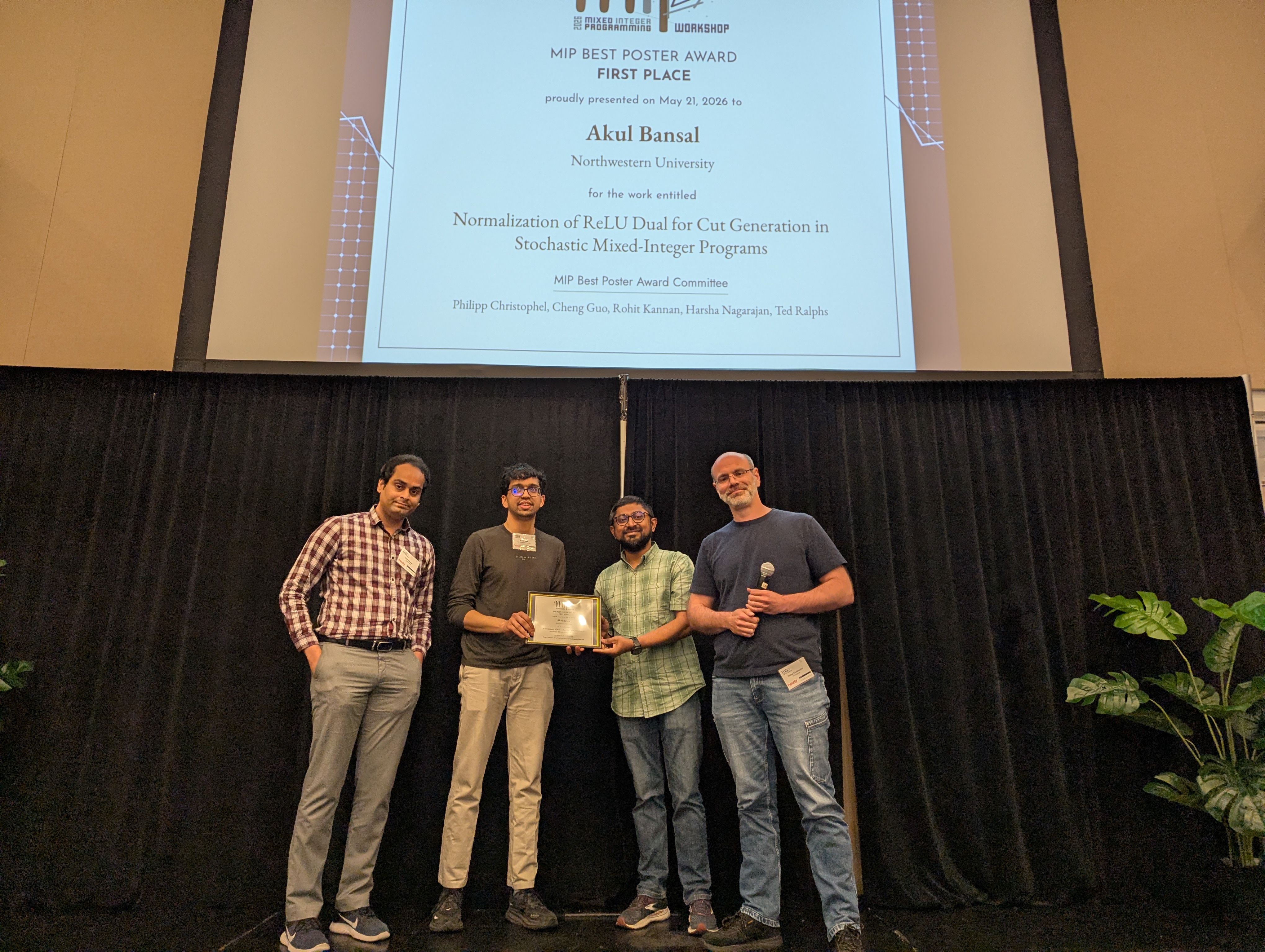
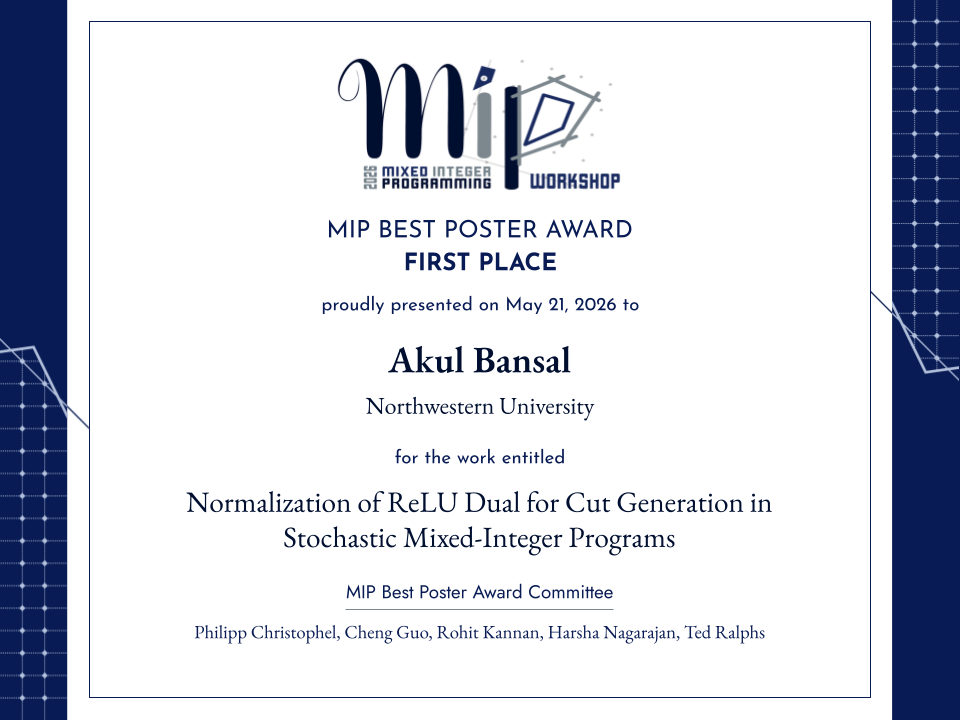
Akul Bansal Northwestern University Normalization of ReLU Dual for Cut Generation in Stochastic Mixed-Integer Programs
Albert Lee Purdue University Mixed-Integer Reaggregated Hull Reformulation of Special Structured Generalized Linear Disjunctive Programs
Amiratabak Bahengam Stevens Institute of Technology A Propellant-Coupled Space Vehicle Routing MILP and Its Hybrid Quantum–Classical Decomposition
Anurag Ramesh Purdue University Investigating Quantum Preconditioning for Mixed Integer Programming Solvers
Apoorva Narula Georgia Institute of Technology Mixed-Integer Programming for Change-point Detection
April Niu Georgia Institute of Technology Boxing points
Arnav Aakash University of Wisconsin–Madison K-Adaptability in Stochastic Optimization with Recourse
Blake Sisson Columbia University De-Risking Solutions to Optimization Problems
Bo Tang University of Toronto NOIR: A MINLP Solver using Neural Overparameterization for Integer Representation
Bouchra Er-Rabbany University of Minnesota, Twin Cities MILP Approaches to Two-Level Resource Allocation with an Application to Opioid Settlements in West Virginia
Boyang Han University of Florida Speeding Up IPs By Slowing Down LPs: GPU-Based Algorithms for Feasible Solutions and Tilted Cuts
Changwon Lee University of Wisconsin–Madison Maximizing Neural Network Sparsity via Mixed-Integer Linear Programming
Chengwenjian Wang University of Minnesota, Twin Cities Balancing adaptability and predictability: K-revision multistage stochastic programming
Cinar Ari Virginia Tech Inertia-parameterized complexity of integer quadratic programming
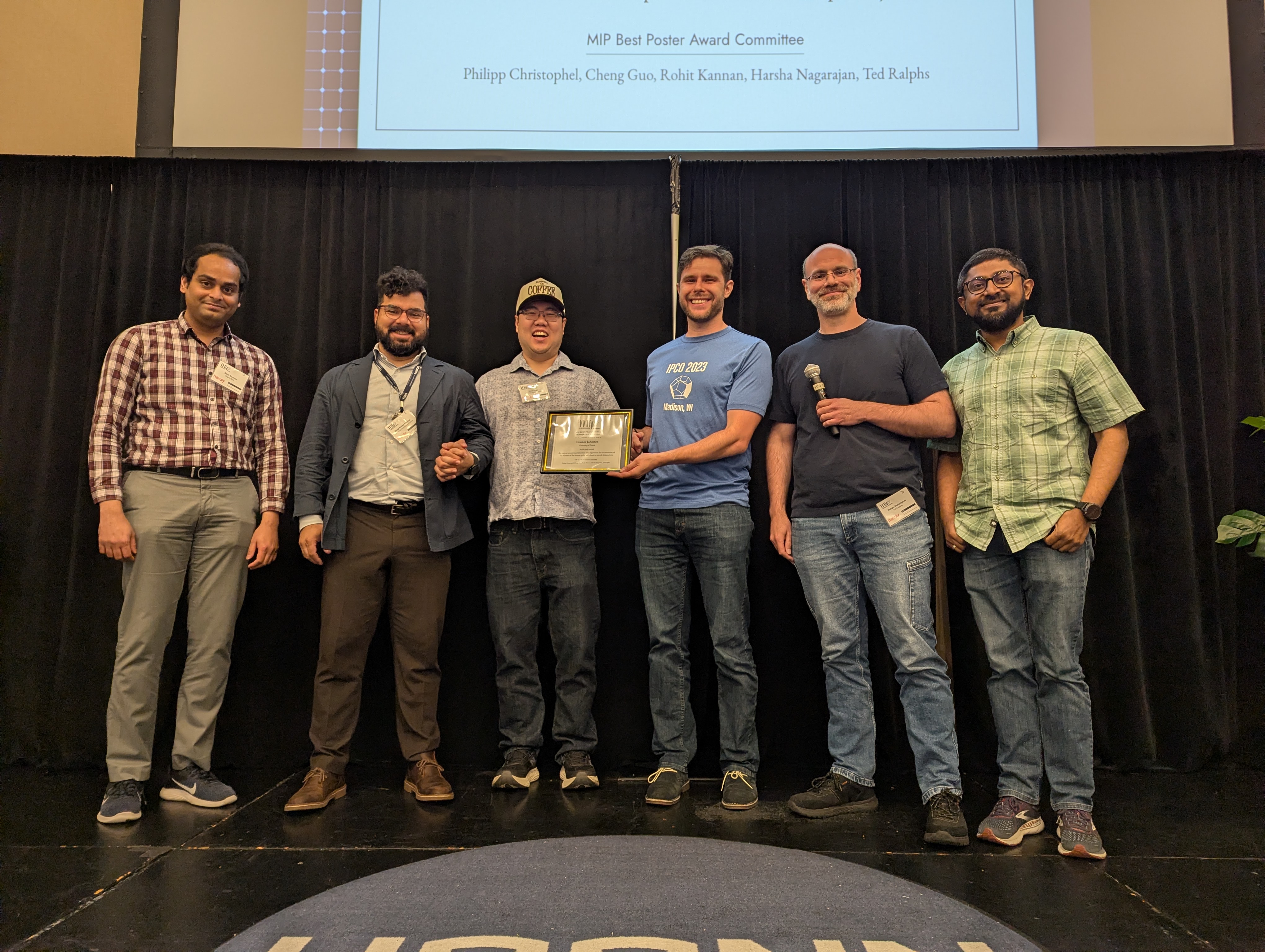
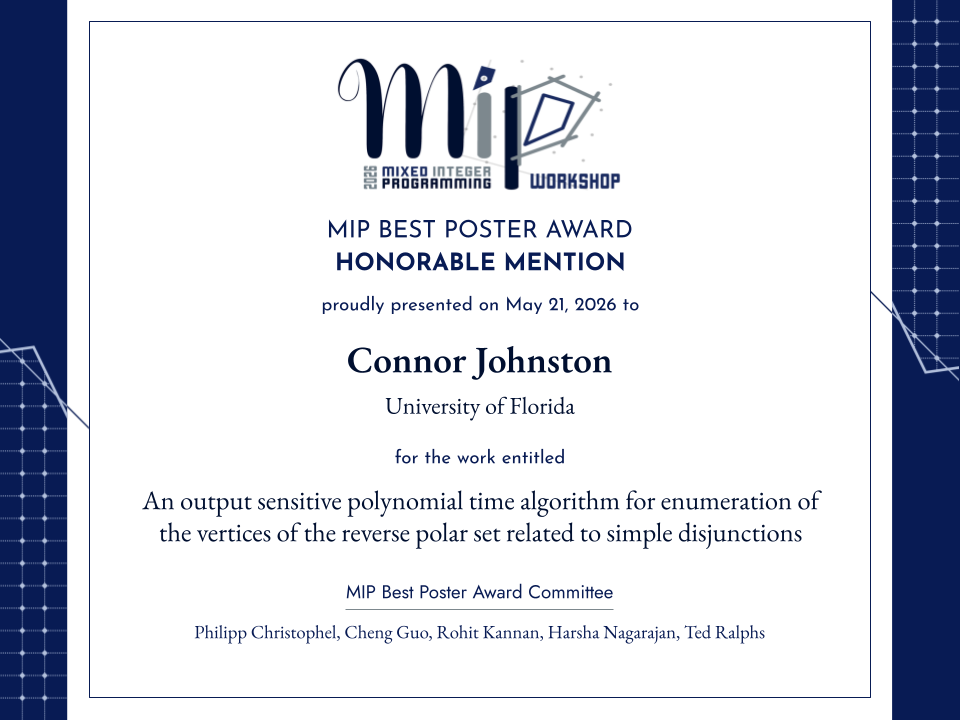
Connor Johnston University of Florida An output sensitive polynomial time algorithm for enumeration of the vertices of the reverse polar set related to simple disjunctions
Fabian Alex Badilla Mera Georgia Institute of Technology Sensitivity Analysis for MIPs using Lagrangian dual multipliers and B&B trees
Forrest Miller Northeastern University Minimum Cost Flow Interdiction with Shifting Supply and Recruitment for Disrupting Human Trafficking Networks
Guxin Du Chinese University of Hong Kong, Shenzhen On the Convexification of a Class of Mixed-Integer Conic Sets
Haoyun Deng Georgia Institute of Technology Bilevel Risk-Averse Routing and Resource Allocation for Urban Air Mobility
Huangrong Sun Ohio State University Contextual Stochastic Optimization under Decision-Dependent Uncertainty via Nonparametric Learning
Igor Lucindo Cardoso Texas Tech University An Iterative MIP Framework for Network-Constrained Portfolio Optimization
Jiaxiao Fang University of Iowa Optimization over Trained Neural Networks: What Neural Network to Use?
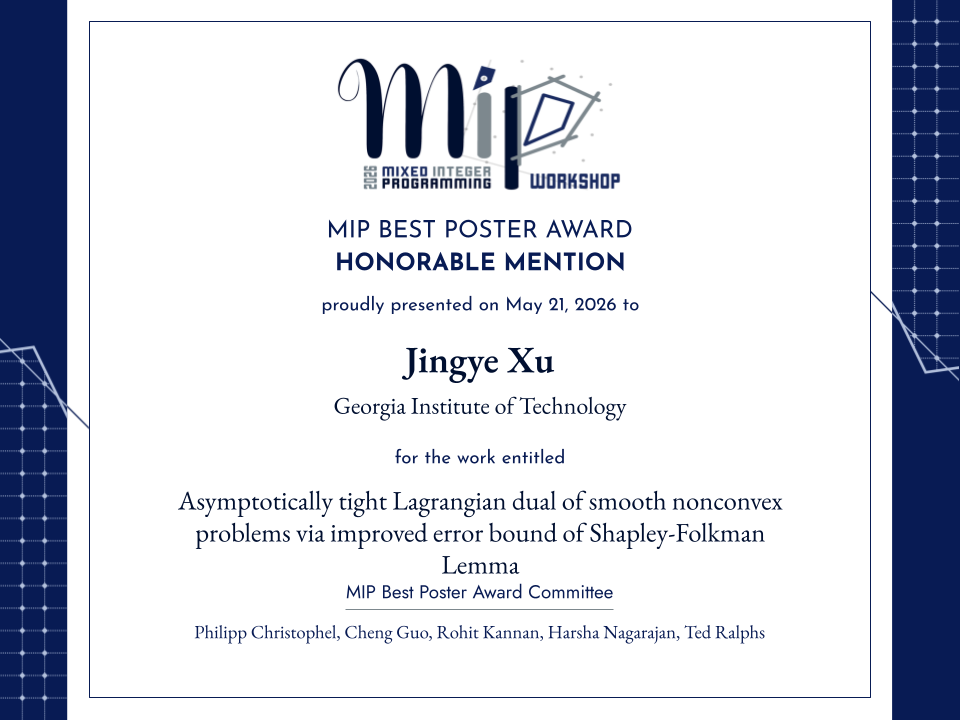
Jingye Xu Georgia Institute of Technology Asymptotically tight Lagrangian dual of smooth nonconvex problems via improved error bound of Shapley-Folkman Lemma
Kaiwen Fang Arizona State University Disjunctive Benders Decomposition: Generating Valid Inequalities within Benders Frameworks
Madeline Colbert University of Iowa Bridging the Gap Between SAA and Constraint Learning in Chance Constrained Optimization
Mingming Xu Clemson University SDP Approach to Quadratic Vertex-Disjoint Paths Problem
Raul Garcia Rice University A Simpler Decomposition Algorithm for A Class of Mixed-Integer Bilevel Programs
Rui Gong Georgia Institute of Technology Deriving Quadratic Assignment Solutions from Semidefinite Relaxations
Ruohong Liu University of Oxford LLM-Guided Adaptive Solver Configuration for Sequential MILP Re-optimization
Ryan Lucas MIT GPU-Accelerated Branch-and-Bound for Sparse Regression with $\ell_0$ Regularization
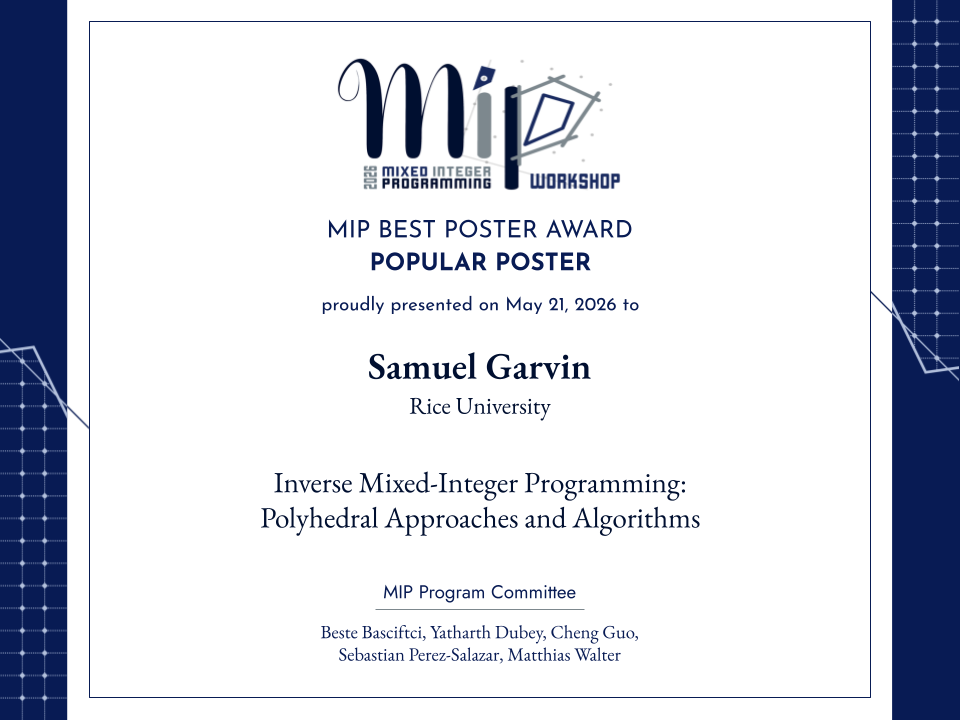
Sam Garvin Rice University Inverse Mixed-Integer Programming: Polyhedral Approaches and Algorithms
Sebastian Vasquez Carnegie Mellon University Network flow-based cuts for binary bilevel programs
Sergey Gusev Purdue University Exact Hull Reformulations for Quadratically Constrained Generalized Disjunctive Programs
Shreyas Bhowmik Indian Institute of Management Ahmedabad Complete Characterization of a Class of Knapsack Polytopes using Minimal Cover Inequalities
Shuai Li Georgia Institute of Technology Isotonic Optimization with Fixed Costs
Siyuan Chen Georgia Institute of Technology Distributionally Robust Universal Classification
Soobin Choi University of Southern California Quadratic Optimization with Sign-Switching Constraints
Tofaranashe Gumbo Rice University A Strong Extended Formulation for the Minimum Broadcast Time Problem.
Waquar Kaleem Pennsylvania State University Offline Model-Based Routing Optimization with MIP-Representable Deep Set Surrogates
Xiang Meng MIT A Branch-and-Bound method via Hyperplane Arrangement for Least Trimmed Squares
Xiangxin An Georgia Institute of Technology Solving ACOPF through Offline Bound Tightening and Outer Approximation
Yongjia Wang University of Wisconsin–Madison Polyhedral Structures for Parametric Linear Programs
Yushan Qu University of Michigan On disjunction convex hulls for generalized cross polytopes
Yutian He University of Iowa Decision-Dependent Distributionally Robust Optimization for Facility Location Problem with Customer Behavior Considerations
Zixuan Feng University of Florida Unlocking More Transplants Safely: Robust Kidney Exchange Avoiding Incompatibility at a Cost
Zongzheng (Jason) Dai RPI Parametric polyhedra in integer programming

Flash Talks

The 2026 MIP Workshop will include several flash talks.

We opened up limited slots for contributed flash talks by "nonstudents" (those who were not eligible for the poster session, such as postdocs, faculty, national lab members, and industry researchers).

The deadline for flash talk submission was April 15, 2026 (11:59pm "Anywhere on Earth" time). The presented talks are listed below.

  • Yongzheng Dai (Georgia Institute of Technology), Progressive Integrality Outer-Inner Approximation for AC Unit Commitment with Conic Formulation

    Motivation. Mixed-integer second-order conic programs (MISOCPs) are increasingly used to model complex systems with nonlinear constraints, such as second-order cone (SOC) relaxations of AC unit commitment (AC-UC), but remain challenging to solve at scale. Outer approximation (OA) is a natural framework for such problems, yet it often suffers from slow convergence due to weak relaxations in early iterations and the need to repeatedly solve expensive mixed-integer master problems. As a result, existing OA approaches struggle to balance bound improvement and computational cost effectively. This motivates the development of new algorithmic strategies that strengthen relaxations early while postponing costly integrality decisions.

    Key Idea. Our key insight is that, for large-scale MISOCPs such as AC-UC, the efficiency of OA depends critically on how integrality is introduced throughout the algorithm. Enforcing integrality too early leads to expensive master problems, while relying solely on continuous relaxations results in weak approximations and slow progress. We therefore treat integrality as a progressively activated modeling component rather than a fixed requirement from the outset. This perspective yields a more balanced OA framework that allocates combinatorial effort only when it becomes algorithmically valuable.

    Method Overview. We implement this idea within an outer-inner approximation framework. The master problem is a linear relaxation that accumulates cutting planes, while the subproblem is a continuous convex conic program obtained by fixing the binary variables. The subproblem provides both a valid upper bound and dual-based (Benders-type, time-block-split) cuts, which are added to the master problem to refine the approximation. Within this framework, we progressively enforce integrality in the master problem. The algorithm begins with an LP-based OA phase, where all integer variables are relaxed and cuts are generated to strengthen the relaxation at low cost. It then transitions to a partial integrality phase, in which integrality is imposed on a subset of variables, leading to smaller mixed-integer master problems that further tighten the formulation. Finally, the full mixed-integer master problem is solved within the same outer–inner framework. This staged design balances relaxation strength and computational effort throughout the solution process.

    Results and Impact. We evaluate the proposed framework on standard AC-UC benchmark instances, including 200-bus and 500-bus systems. Computational results show that the proposed method significantly improves performance compared to both a standard OA approach and commercial solvers, while providing more robust convergence across multiple load scenarios. The proposed framework suggests a new perspective on handling integrality in OA-based algorithms by treating it as a progressively activated component. This idea is broadly applicable to large-scale mixed-integer convex optimization and has the potential to improve solution strategies beyond AC-UC.

  • Anna Deza (Mitsubishi Electric Research Laboratories), Generalized Sensitivity for LPs and MIPs

    Abstract: Sensitivity analysis studies how information obtained from solving one nominal optimization problem can be used to infer information about problems that are close to the nominal one. In this flash talk, we consider the problem of computing fast lower bounds for MILPs under generalized perturbations. While most existing techniques consider perturbations that are either isolated to the constraint right-hand side, or objective coefficients, our approach allows simultaneous perturbations to all parts of the MILP, including the constraint matrix coefficients. However, we will use a key assumption that all variables are bounded.

    This talk will derive the proposed lower bounding technique for both LPs and MILPs under generalized perturbations. For LPs, we prove that in the worst-case, the quality of the proposed lower bound degrades linearly with perturbation magnitude. Building on the LP case, we derive a framework for MILP lower bounds, generalizing the work of Schrage and Wolsey (1985). We conclude with computational results.

    The talk is based on joint work with Fabian Badilla Mera and Santanu S. Dey.

  • Justin Dumouchelle (University of Calgary), Fast Neural Value Function Surrogates for Nested Mixed-Integer Programs

    Abstract: Mathematical optimization is an invaluable framework for modeling and solving decision-making problems, with many successes in deterministic single-level settings (e.g., mixed-integer linear or nonlinear optimization). However, many real-world problems require accounting for uncertainty or the reaction of another agent. Paradigms such as stochastic programming, bilevel optimization, and robust optimization can model these settings, but are significantly more computationally challenging than their deterministic counterparts, especially when discrete decisions are involved.

    This work presents a unified framework based on neural value function approximation, in which expensive nested optimization problems are replaced with learned surrogates that can be efficiently optimized over. We show how this approach can be adapted to stochastic programming, robust optimization, and bilevel optimization. Empirically, our methods achieve solution quality comparable to, and in some cases significantly better than, state-of-the-art algorithms across all three domains, often within a fraction of the running time. The datasets and corresponding frameworks, Neur2SP (NeurIPS’22), Neur2RO (ICLR’24), and Neur2BiLO (NeurIPS’24), are open-sourced to support further research.

    This work is based on joint work with Rahul Patel, Esther Julien, Jannis Kurtz, Merve Bodur, and Elias Khalil.

  • Jiachang Liu (Cornell University), GPU-Friendly and Linearly Convergent First-Order Methods for Certifying Optimal k-Sparse GLMs

    Abstract: Sparse generalized linear models (GLMs) are essential tools in machine learning and statistics, with broad applications in healthcare, finance, engineering, and science. In this work, we study the global optimization of cardinality-constrained GLMs. While many scalable approaches rely on convex surrogates, such as the lasso, or other heuristics, these approximations can yield poor solutions in the presence of high-dimensional or highly correlated features. This limitation is particularly problematic in high-stakes applications such as healthcare, where accuracy, reliability, and interpretability are essential. We therefore focus on certifiably optimal solutions to the exact l0-constrained formulation.

    These problems are NP-hard, and a standard approach is to solve them with mixed-integer programming using branch-and-bound (BnB), which requires valid lower bounds at every node of the search tree. We focus on computing these lower bounds by solving perspective relaxations, which are strong but computationally challenging for large instances. Interior-point methods are a standard option, but they do not scale well because they rely on solving linear systems, have cubic worst-case complexity in the number of variables, and are difficult to parallelize on modern hardware such as GPUs. First-order methods are more scalable and warm-start friendly, but to truly benefit from GPUs they must avoid expensive subroutines that cannot be parallelized. Moreover, for use inside BnB, they must generate valid lower bounds with strong convergence guarantees, not merely good primal iterates.

    This motivates the central question of our work: can we solve perspective relaxations within BnB and obtain valid lower bounds using a GPU-friendly first-order method with provable linear convergence? Our answer is positive. We first reformulate the perspective relaxation as an unconstrained convex composite problem with a novel nonsmooth regularizer implicitly defined by the perspective function. We then analyze a more general composite structure and uncover two favorable geometric properties. Under suitable regularity conditions, the primal problem satisfies quadratic growth, while the dual problem satisfies quadratic decay, a dual counterpart to primal quadratic growth. By exploiting these properties, we propose a gap-based restart scheme that applies broadly to convex composite problems beyond perspective relaxations.

    This scheme accelerates a broad class of proximal methods, including fixed-stepsize, linesearch-based, and linesearch-free variants, and gives provable linear convergence rates for both primal and dual objectives and sequences. For sparse GLMs, we prove that the implicit perspective regularizer satisfies the required geometric conditions and show that both its function value and proximal operator can be evaluated exactly in log-linear time. This enables efficient, GPU-friendly first-order methods without solving expensive conic subproblems. Experiments on synthetic and real-world datasets show one-to-two-orders-of-magnitude speedups on CPUs, with an additional order-of-magnitude improvement on GPUs, for computing dual bounds and certifying optimal solutions of large-scale sparse GLMs.

    This is joint work with Andrea Lodi and Soroosh Shafiee.

  • Quentin Louveaux (University of Liège), Sensitivity for linear changes of the constraint matrix of a MIP

    Abstract: In this work, we investigate how the optimal value of a (mixed-integer) linear program changes when its constraint matrix is linearly perturbed. We show that, even in low-dimensional continuous settings, this optimal value function can exhibit surprisingly complex and irregular behavior. The flash talk is essentially based on illustrations on how this optimal value function behaves. We describe the cases in which the behaviour is structured and the cases in which it is erratic. Furthermore, we shortly present a methodology to address such parametric problems, in particular by computing an upper or lower bound on the optimal value function. For further details, we refer to our recent paper on the topic.

  • Joseph Paat (University of British Columbia), A characterization of maximal inhomogeneous-quadratic-free sets

    Abstract: Given a closed set $S \subseteq \mathbb{R}^d$, we say that a full-dimensional closed convex set is $S$-free if its interior is disjoint from $S$. There are various optimization-related applications of $S$-free sets, including optimality certificates and intersections cuts, with the latter perhaps being the most notable. Among all $S$-free sets, it is the inclusion-wise maximal $S$-free sets that typically appear in application, perhaps because they generate the strongest intersection cuts. Maximal $S$-free sets and intersection cuts have been extensively studied for various choices of $S$. Interestingly, there is a descriptive characterization of maximal lattice-free sets as polyhedra with certain properties.

    Muñoz, Paat and Serrano gave a descriptive characterization maximal $S$-free sets when $S$ corresponds to a homogeneous quadratic inequality. In this work, we characterize $S$-free sets when $S$ corresponds to an inhomogeneous quadratic inequality. Together with Muñoz et al.'s work, this characterizes all maximal $S$-free sets defined by a single quadratic inequality. In this flash talk, we give an overview on this problem and provide more precise descriptions of these maximal inhomogeneous-quadratic-free sets.

  • Anirudh Subramanyam (Pennsylvania State University), Neural-Embedded Mixed-Integer Optimization for Vehicle Routing Problems

    Abstract: A large class of vehicle routing problems can be viewed as a two-level combinatorial problem: first assign customers to centers (e.g., vehicles, depots, satellites, or days) and then solve an induced routing subproblem at each center. This structure is natural in applications, but computationally difficult for optimization. Indeed, even the basic capacitated vehicle routing problem is NP-hard, and the cost of an assignment depends on the downstream routing problem rather than a simple linear expression. As a result, existing methods have relied on exact arc-based or route-based formulations or on customized (meta)heuristics.

    We propose a neural-embedded mixed-integer optimization framework for this broad class of structurally decomposable routing problems. The key observation is that the induced routing cost at a center depends on the set of assigned customers and is therefore permutation-invariant. We exploit this structure by training a Deep Sets surrogate to predict routing cost from assigned-customer features, and then embed the trained predictor directly within a MIP using recent tools for optimization over trained neural networks. The resulting model stays at the assignment level, can be handled by off-the-shelf MIP solvers, and accommodates application-specific side constraints without designing a new heuristic for each variant.

    We will present location-routing as a concrete testbed and briefly discuss offline model-based routing optimization as a broader application in which learned surrogates capture behavior-driven routing costs from historical data.

  • Hamid Validi (Texas Tech University), The Longest Induced Path Problem: Approximation Hardness, Primal Heuristics, and MIP Formulations

    Abstract: The longest induced path problem (LIP) seeks a maximum-cardinality vertex subset that induces a simple path in a graph. We prove that LIP is NP-hard to approximate within a factor of $n^{(1/2 − \varepsilon)}$ for any $\varepsilon > 0$, even on bipartite graphs. Motivated by this hardness, we develop a polynomial-time multi-strategy heuristic that warm-starts two complementary exact methods: a separator-based branch-and-cut formulation and a compact flow-based formulation strengthened by new valid inequalities. On the 23 open challenging instances of Marzo et al. (2022), our heuristic improves the state-of-the-art G-HLIPP incumbent on 21 instances, the best MIP gap improves the best previously reported gap on 21 instances, and three open toroidal instances are solved to optimality.

  • Jose A. Ventura (Pennsylvania State University), Supplier Selection and Order Allocation in a Decentralized Supply Chain considering Price-sensitive Demand and Profit Sharing

    Abstract: Outsourcing materials and components in manufacturing systems has become a turning point in modern supply chain management to facilitate high performance and business growth in an interconnected world. This trend has made supplier selection and order lot-sizing critical for businesses, leading to studies focused on optimizing these decisions driven by the need to improve efficiency. In this research work, we study a supplier selection and order allocation problem in a decentralized three-stage supply chain with price sensitive demand for products. A mixed integer nonlinear programming model is proposed with the objective of maximizing the overall supply chain profit while applying a profit-sharing policy that ensures a fair distribution of profit among all participating partners. To help overcome a possible negative impact due to profit-sharing, we have developed a price-shifting mechanism to adjust the price of materials produced by suppliers to guarantee the selection of the most efficient vendors. Computational results show that the price-shifting process has a positive influence on the supply chain’s performance as profit increases.

  • Shunyu Yao (Department of Business Analytics, University of Iowa), Chance-Constrained Maximum Clique Problem

    Abstract: The Maximum Clique Problem (MCP) is a fundamental combinatorial optimization problem with numerous applications in computer science, operations research, and data analysis. The goal is to find the largest subset of vertices for a simple graph such that every pair of vertices in the subset is connected by an edge (i.e., the induced subgraph is a clique). However, in many real-world networks, connections can be inherently uncertain, and ignoring this uncertainty may lead to models that do not accurately reflect reality. In this work, we study the Chance-Constrained Maximum Clique Problem on random graphs, also referred to as the Maximum Probabilistic Clique Problem (MPCP), in which each edge exists independently with a given probability and the goal is to identify a largest vertex subset whose induced subgraph forms a clique with probability at least θ.

    We develop an exact mixed-integer linear programming (MILP) formulation for MPCP by leveraging the complement graph structure and introducing edge variables to capture interactions among selected vertices. By exploiting a logarithmic transformation of the chance constraint, the probabilistic requirement can be reformulated as a fractional knapsack constraint over edge variables, yielding an MILP formulation with a polynomial number of constraints. To solve this formulation efficiently, we propose a hybrid decomposition framework that combines delayed constraint generation (DCG) with Lagrangian-based cuts. The DCG procedure dynamically enforces linking constraints between vertex and edge variables, while solving Lagrangian relaxation problem produces valid cuts that strengthen the formulation. This separation of fractional knapsack structure and pairwise linking constraints leads to a more effective solution process compared to directly applying state-of-the-art MILP solvers. Computational experiments on a variety of random graphs validate the effectiveness of the proposed methods, which are specifically tailored to the probabilistic and combinatorial structure of the problem.

  • Qimeng (Kim) Yu (Universite de Montreal), Valid Inequalities for Binary Bilevel Problems with Lower-Level Graph Reformulations

    Abstract: Bilevel optimization is a powerful modeling paradigm, and valid inequalities play a central role in its solution. Existing methods largely focus on eliminating bilevel-infeasible integer points within branch-and-cut frameworks. In contrast, we study binary bilevel problems whose lower level admits a shortest-path reformulation and, to the best of our knowledge, provide the first systematic investigation of the underlying mixed-integer set to exclude fractional solutions as well. Leveraging a disjunctive programming framework, we characterize the space of valid inequalities for bilevel-feasible integer points and reveal a fundamental connection to flow structures on the follower’s graph. Building on this perspective, we derive new classes of inequalities and propose a strengthening procedure for value-function cuts informed by these families, which remains effective in the absence of an explicit graph reformulation. Preliminary computational results will be presented and discussed.

    This is joint work with Bruno Machado Pacheco and Margarida Carvalho.

Credits

Logo-Design by ©Julia Silbermann (Font-Credits: Cornerstone, by Zac Freeland). Website hosted at GitHub Pages. Layout based on skeleton using Raleway font.